
But then, like Roxane, she would understand everything in a flash. No, no, my dear beloved-I never loved you. Now that was a good technique. Tell her I do not love her, and please excuse the oversight. She would understand my witticism (was she not a précieuse?) and might lean toward me and say something like Don’t be a fool, but with unhoped-for tenderness. Blushing, she would touch her fingers to my cheek.
In short, my opening was to be a masterpiece of wit and subtlety, irresistible-because I, since I loved her, could not imagine that she did not share my feelings. I had it wrong, like all lovers; I had given her my heart and asked her to do as I would have done, but that is how things have gone for millennia. Were it otherwise, literature would not exist.
Having chosen the day, the hour, having created all the conditions for the happy knock of Opportunity, I found myself standing in front of the gate to her house at ten minutes to four. At five minutes to four, I felt that too many people were passing by, and I decided to wait inside the gate, at the foot of the stairs.
After several centuries, which passed between five to four and five past four, I heard her come into the foyer. She was singing. A song about a valley-I can recall only a vague tune, not the words. The songs in those years were terrible, unlike those of my childhood. They were the idiotic songs of the idiotic postwar: "Eulalia Torricelli from Forli," "The Firemen of Viggiù," "Nice Apples, Nice Apples," "Gascony Cadets"-at best they were sticky declarations of love, such as "Go Celestial Serenade" or "I Could Fall Asleep in These Arms of Yours." I hated them. At least Cousin Nuccio danced to American rhythms. The idea that she might like such things may have cooled me off for a moment (she had to be as exquisite as Rox-ane), though I doubt I was thinking clearly at the time. Indeed, I was not even listening, I was simply awaiting her appearance, and I spent at least ten full seconds suffering through a nervous eternity.
I stepped forward just as she reached the stairs. If someone else were telling me this story, I would remark that we could use some strings at this point, to heighten the anticipation, to create atmosphere. But at the time all I had was that miserable song I had just overheard. My heart was beating with such violence that on this occasion, for once, I could have reasonably concluded I was ill. Instead I felt charged with a wild energy, ready for the supreme moment.
She appeared before me, then stopped, surprised.
I asked her: "Does Vanzetti live here?"
She said no.
I said Thank you, excuse me, I was mistaken.
And I left.
Vanzetti (who the hell was he?) was the first name that, in the grip of panic, popped into my head. Later, that night, I convinced myself that it was good that it had happened that way. It was the ultimate stratagem. Because if she had begun to laugh, had said, What’s got into you, you’re very sweet, I’m flattered, but you know, I’ve got other things on my mind-what would I have done then? Was I going to forget her? Would such a humiliation have caused me to think her a fool? Would I have stuck to her like flypaper for the days and months to come, pleading for a second chance, becoming the laughingstock of the school? By keeping quiet, on the other hand, I had held on to everything I already had, and I had lost nothing.
She did in fact have other things on her mind. There was a college boy, tall and blondish, who sometimes came to wait for her at the school gate. His name was Vanni-whether that was his first or last name I do not know-and one time when he had a Band-Aid on his neck he really did say to his friends, with a cheerfully corrupt air, that it was only a syphiloma. Then one day he arrived on a Vespa.
Vespas had only recently come out. As my father used to say, only spoiled kids had them. For me, having a Vespa was like going to the theater to see dancing girls in panties. It was on the side of sin. Some of my friends mounted theirs by the school gate, or showed up on them in the evenings in the piazza, where everyone shot the breeze for hours on the benches in front of a fountain that was usually sick, some of them recounting things they had heard about the "houses of tolerance," or about Wanda Osiris in the magazines-and whoever had heard something gained in the eyes of the others a morbid charisma.
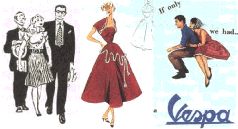
The Vespa, in my eyes, was the transgression. It was not a temptation, since I could not even conceive of possessing one myself, but rather the evidence, both plain and obscure, of what could happen when you went off with a girl sitting sidesaddle on the rear seat. Not an object of desire, but the symbol of unsatisfied desires, unsatisfied through deliberate refusal.
That day, as I went back from Piazza Minghetti toward the school, in order to walk past her and her friends, she was not with her group. As I quickened my pace, fearing that some jealous god had snatched her from me, something terrible was happening, something much less holy, or, if holy, hellishly so. She was still there, standing at the bottom of the school stairs, as if waiting. And here (on his Vespa) came Vanni. She mounted behind him and clung to him, as if she were used to it, passing her arms beneath his and pressing them to his chest, and off they went.
It was already the period when the skirts of the war years, which had risen to just above the knee, or to the knee for flared skirts-the kind that graced the girlfriends of Rip Kirby in the first American postwar comics-were giving way to long, full skirts that reached to mid-calf.
These were not more prim than the shorter ones, indeed they had a perverse grace of their own, an airy, promising elegance, all the more so if they were flapping gently in the breeze as the girl vanished clutching her centaur.
That skirt was a modest, mischievous undulation in the wind, a seduction through an ample, intermediary flag. The Vespa faded regally into the distance, like a ship leaving a wake of singing foam, of capering, mystic dolphins.
She faded into the distance that morning on the Vespa, and for me the Vespa became even more a symbol of torment, of useless passion.
And once again, her skirt, the oriflamme of her hair-but seen, as always, from the back.
Gianni had told me about it. Through an entire play, in Asti, I had looked only at the back of her neck. But Gianni had failed to remind me-or I had not given him a chance-of another theater evening. A touring company came to our city to put on Cyrano. It was my first opportunity to see it staged, and I convinced four of my friends to reserve seats in the gallery. I looked forward to the pleasure, and pride, of being able to anticipate the lines at crucial moments.
We arrived early, we were in the second row. A little before it started, a group of girls took their seats in the first row, right in front of us: Ninetta Foppa, Sandrina, two others, and Lila.
Lila was sitting right in front of Gianni, who was next to me, so I was looking at the back of her neck once again, though if I tilted my head I could make out her profile (not now, her face remains solarized). Rapid greetings, oh you too, what a nice coincidence, and that was all. As Gianni said, we were too young for them, and if I had been a star with the lozenge in my mouth, I was an Abbott and Costello kind of star, at whose jokes one laughs, but with whom one does not fall in love.
For me, though, it was enough. Following Cyrano, line by line, with her in front of me, multiplied my vertigo. I no longer remember the actress who played Roxane on stage, because my Roxane was right before my eyes. I felt I could tell when she was moved by the drama (who is not moved by Cyrano, written to wring tears from the stoniest heart?) and I was utterly convinced that she was moved not with me, but over me, because of me. I could ask for nothing more: myself, Cyrano, and her. The rest was the anonymous crowd.