
“That’s a little easier to take seriously,” I said. “Fine.” Because I had the sense that Criscan was getting ready to veer off into a long tedious defense of Halikaarn. “So how does this faculty figure into his account of what’s happening in this diagram?”
“There is some other type of given, other than what we can detect with our eyes, ears, and so on, that somehow reaches the Arbran Causal Domain and that is perceived by Halikaarn’s Organ,” Criscan said.
“That almost raises more questions than it answers,” Lio pointed out.
“It doesn’t answer any questions at all,” Criscan returned, “this is not really an attempt to answer questions but a way of setting one’s pieces out on the board, agreeing on terminology, and so on. So. The theorical entities in the HTW—triangles, theorems, and other pure concepts—are called cnoöns.”
“Cnoöns, check!” Lio said.
“Between us and the HTW is a relationship, the details of which are subject to further debate, which Halikaarn didn’t name, but it’s symbolized by this arrow, and so people have ended up calling it Halikaarn’s Arrow.”
“Halikaarn’s Arrow, check!”
“A Halikaarn’s Arrow is a one-way conduit for givens about the cnoöns. These givens enter the Arbran Causal Domain through a poorly understood process called the Hylaean Flow and there impinge on Halikaarn’s Organ, which is how we become aware of them.”
“Hylaean Flow, check!”
Criscan had decided that he didn’t like Lio very much, but was making a visible effort to tolerate him. I stepped into the position of interlocutor, shouldering Lio aside. Lio reacted melodramatically, sprawling off to the shoulder of the road as if he had been struck by a speeding fetch. I ignored him. “So,” I said to Criscan, “now that we have the terminology bolted down, where are we going with it?”
“Now we’re going to skip ahead a millennium and a half,” Criscan said, “and talk about the move that Erasmas and Uthentine made, when they decided to see what happened if they construed this diagram as just one, particularly simple example of a Directed Acyclic Graph or DAG. Here ‘directed’ just means ‘arrows are unidirectional.’ The modifier ‘acyclic’ means that the arrows can’t go around in a circle, i.e., if we have an arrow from A to B, we can’t also have an arrow from B to A.”
“Why bother stipulating that, I wonder?”
“The property of being acyclic is required in order to preserve the fundamental doctrine of Protism: that the cnoöns are changeless. If it were possible for the arrows to go around in a circle, it would mean that events in our universe could alter things in the Hylaean Theoric World.”
“Of course,” I said, “pardon me, that’s obvious now that you mention it.”
“This diagram,” said Criscan, drawing my attention back to his two-box sketch, “just seems wrong, to a metatheorician.”
“What do you mean, just seems wrong? How can you get away with statements like that?”
“It is a legitimate move in metatheorics. You have to be continually asking yourself, ‘why are things thus, and not some other way?’ And if you apply that test to this diagram, you immediately run into a problem: there are exactly two worlds. Not one, not many, but two. One might draw such a diagram having only one world—the Arbran Causal Domain—and zero arrows. That would draw very few objections from metatheoricians (at least, those who are not Protists). One might, on the other hand, assert ‘there are lots of worlds’ and then set out to make a case for why that is plausible. But to say ‘there are two worlds—and only two!’ seems no more supportable than to say ‘there are exactly 173 worlds, and all those people who claim that there are only 172 of them are lunatics.’”
“Okay, if you put it that way, I agree that there is a certain odor of crankiness about it. Like when Deolaters claim that there are thirty-seven books making up their scripture but that anyone who proposes a different number must die.”
“Yes, and this accounts, at least in part, for the way Protism raises hackles in some quarters. So the Erasmas/Uthentine move is simply to say ‘what’s true of one DAG ought to be true of another’ and to consider other DAGs having other numbers of worlds.”
Criscan took up his stick again, and scratched out a diagram like this one:

“They called this one the Freight Train,” Criscan announced. “In the Freight Train topology, there is a (possibly infinite) plurality of Hylaean Theoric Worlds that stand in a hierarchical relationship, each ‘more Protan’ than the last and ‘less Protan’ than the next. This introduces the notion of Analog Protism. In Simple Protism, being Protan is a binary, digital property.”
“A world is either Protan, or it isn’t,” I translated.
“Yes. Here, on the other hand, gradations of Protanness are possible.”
“Not just possible,” I pointed out, “they are required.”
“Yes,” Criscan said, a little distractedly, for he was already at work making another diagram.
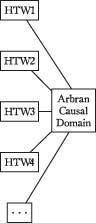
“This is the Firing Squad,” he said. “In the Firing Squad topology, some number of Hylaean Theoric Worlds are connected by direct linkages to the Arbran Causal Domain. This introduces the notion of separate Protan domains that have nothing to do with one another. In Simple Protism, all possible theoric entities are lumped together in one box labeled ‘Hylaean Theoric World,’ which seems to imply that, within that box, they can stand in cause-and-effect relationships to one another. But perhaps this is not the case, and each mathematical entity should be isolated in a separate World as above.”
He now spent a while drawing a much more complex diagram:
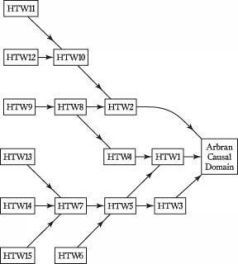
“The Reverse Delta,” Criscan said. “It has the topology of a river delta, but the arrows run backwards, hence the name. The Reverse Delta is most easily summed up by saying that it combines the properties of the Freight Train and Firing Squad topologies.”
“Got it,” I said, after a moment’s thought—for Criscan, I sensed, was testing me. “It’s got Analog Protism—many gradations of Protanness—and it’s got the idea, from the Firing Squad, that different cnoöns might have nothing to do with one another—might come from altogether different Theoric Worlds.”
Criscan did not respond one way or the other, since he was busy with his stick again. “The Strider,” he proclaimed.
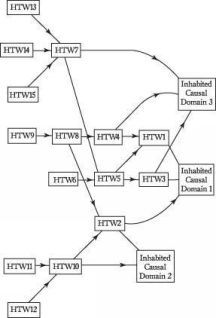
“Strider? In what way does it stride?” I asked.
“It’s named after a kind of tree—a tropical species that connects to the ground through multiple root systems. As you can see, it is similar to a Reverse Delta topology. The only difference is that the Strider contains more than one inhabited cosmos. You’ll note I changed the name.”
“Yes. Up until now, it’s always ended with arrows going to the Arbran Causal Domain. But here you are assuming a polycosmic scheme—multiple inhabited cosmi, causally disconnected from one another.”
“That’s right. Causally disconnected, but—and this is important—non-causally correlated in that they share knowledge of the same cnoöns. The inhabitants of these other cosmi receive the Hylaean Flow from the same sources as ours. As a result they could, for example, have the Adrakhonic Theorem for the same reason we do.
“And this finally leads us to the Wick.”
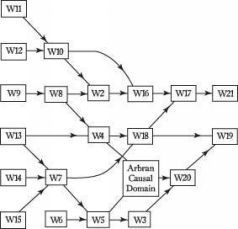
“The Wick is a fully generalized DAG,” Criscan said. “The Hylaean Flow moves through it from left to right—from more Protan to less Protan worlds—but here we are taking Analog Protism to its logical extreme in that no distinction is drawn between types of worlds.”
“I see ours there,” I said, pointing to the one labeled “Arbran Causal Domain.”