
The Battle of Ayn Jalut
While the advent of the Mongols brought panic and chaos to much of the Muslim Near East, their arrival infused the Mamluk world with a new sense of unity and purpose. In November 1259, Qutuz used the Mongol threat to justify his overthrow of the existing young sultan and had himself proclaimed as the new ruler of Egypt. At the same time, al-Nasir’s grip on power was faltering. Stationed near Damascus, the Ayyubid emir seems to have been wholly immobilised by fear as the Mongols advanced on Aleppo–certainly he did nothing to react, even as streams of refugees poured into southern Syria from as far afield as Persia.
In early 1260 Hülegü laid siege to Aleppo, with the aid of Hethum and Bohemond VI, and by the end of February the city had been captured and subjected to a six-day-long orgy of violence. Bohemond personally set fire to the city’s main mosque and although he was later excommunicated by the Latin Church for aiding the Mongols, the prince made significant territorial gains as a result of the 1260 pact, including the reassertion of Frankish control over the port of Latakia. Hülegü moved on from Aleppo to overcome the likes of Harim and Homs, and soon attained full dominion of northern Syria. News of these events caused al-Nasir to flee Damascus and the city’s populace elected to surrender to the Mongols rather than face Aleppo’s fate. Thus, in March 1260, the Mongol general Kitbuqa arrived to occupy Islam’s ancient Syrian capital. The cowering al-Nasir was soon captured and sent to Hülegü–where, for the time being, he was treated as a valuable hostage–but news arrived of Möngke’s death, and Hülegü decided to leave Syria with the vast bulk of his army, returning east to oversee the succession of his brother Kublai as Great Khan. This left Kitbuqa in command of Mongol Syria, albeit with a much-reduced host at his disposal, but even so he received the surrender of Ayyubid Transjordan that summer.
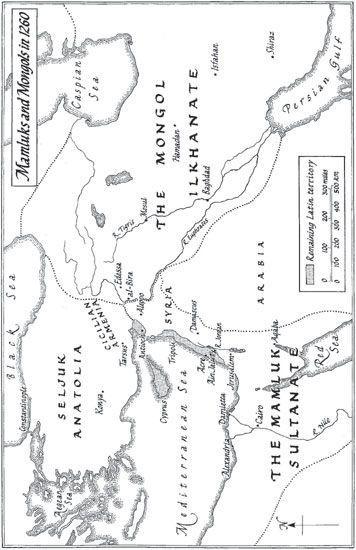
Mamluks and Mongols in 1260
With the Mongols having swept into the Holy Land largely unopposed, overturning the Ayyubid world, it was now questionable whether any Levantine power had the will and resources to stem their advance. The Franks of the kingdom of Jerusalem did not share Bohemond of Antioch’s ready willingness to side with the Mongols, conscious of the fact that to do so might simply be to exchange a Muslim enemy for another, even more dangerous, pagan foe. Hoping to avoid any direct confrontation, the Latins adopted a policy of neutrality.3
By the middle of 1260, therefore, only one force remained that might be capable of opposing the Mongol horde–Mamluk Egypt. By this time, Baybars had recognised that his Ayyubid paymasters would be unable to resist the Mongols, and thus he negotiated a rapprochement with Qutuz, travelling with the remaining members of the Bahriyya to Cairo in March. There a tense concord held, but a current of mutual animosity and suspicion swirled just beneath the surface. Both men were aware of the other’s ambition and Qutuz’s role in Aqtay’s murder was fresh in Baybars’ mind. One Muslim chronicler acknowledged that the profound hatred each held for the other was clear in their eyes.
The Mamluks now faced a defining question: whether to confront or placate the Mongols. On this issue, at least, Qutuz and Baybars were in resolute agreement. Early that summer, an embassy from Hülegü arrived in Cairo demanding Mamluk surrender. The envoys were summarily butchered, their bodies cut in half and their heads hung from one of Cairo’s gates. With this extraordinarily defiant statement of intent the Mamluks went to war. Rather than wait in Egypt, in the hope of repelling an invasion on home ground, they chose to confront Kitbuqa head-on, while his army was still in a weakened state. If successful, this bold strategy promised to bring the Mamluks near-total dominion of the Near East. But the risks were colossal, for they involved direct battle with the Mongols–an invincible enemy, before which all other armies had fallen.
In midsummer 1260 the Mamluks marched out of Egypt, rallying some additional Muslim troops who had formerly served the Ayyubids. Baybars was appointed as commander of the Mamluk vanguard and, together with Qutuz, formulated a plan of attack. Some attempt was made to draw the Franks into an active alliance. They refused, holding to their policy of neutrality, but did permit the Muslim host to march north unhindered through Latin territory to Acre. News of this advance brought Kitbuqa, then based in Baalbek (Lebanon), south, with additional troops levied from Georgia, Cilician Armenia and Muslim Homs.
The great battle to decide the Near East’s fate took place at Ayn Jalut, in Galilee–where Saladin had sought to confront the Franks in 1183. Leading the vanguard, Baybars found the Mongol army camped beside this small settlement, at the foot of Mount Gilboa. He and Qutuz then led their Mamluk army south-east down the Jezreel valley and launched their attack on 3 September 1260. The opposing armies appear to have been roughly equal in terms of numbers–with somewhere between 10,000 and 12,000 troops in each host–so, by the norms of medieval warfare, both sides were taking a perilous gamble. Qutuz and Baybars demonstrated skill and bravery in command, withstanding two massive charges, and, at a key moment, the Muslims from Homs positioned on the Mongol left wing fled the field. This turned the battle in the Mamluks’ favour, as they managed to surround the Mongols and slay Kitbuqa. In one of the epochal moments of history, the seemingly unstoppable tide of Mongol expansion was halted by the new champions of Islam.
Only one arm of the great Mongol Empire had been defeated, and the spectre of retaliation remained–as yet unable to return to the Near East, an incensed Hülegü responded to news of the setback by executing al-Nasir. But the victory at Ayn Jalut proved critical in sealing the future ascendancy of the Mamluk sultanate. In the immediate wake of the battle, Qutuz assumed control of Damascus and Aleppo, installing two of his allies as governors. Baybars’ ambitions and expectations were slighted by these arrangements, because Qutuz broke a promise to reward him with the rule of Aleppo (perhaps understandably judging that it would be folly to establish a rival in power so far from Egypt). Together, the sultan and his disgruntled general set out on the triumphant return journey to Egypt.4
Around 22 October 1260, Qutuz and his emirs were crossing the Egyptian desert en route to Cairo when the sultan called a pause to the march so that he might engage in one of his favourite pastimes–hare coursing. Baybars and a small group of mamluks agreed to accompany him on the hunt, but once away from the main camp, they murdered Qutuz. Numerous and varying accounts of the coup survive, but it appears that Baybars asked the sultan for a favour (probably the gift of a slave girl), and, when Qutuz acceded, reached out to kiss the sultan’s hand. At that moment, Baybars gripped Qutuz’s arms to prevent him from drawing a weapon, and another emir struck him in the neck with his sword. After that first attack, the other conspirators rushed in and the sultan died beneath a cascade of blows.
Baybars seems to have been the plot’s ringleader, but his position was not yet assured. Riding back to the camp, a council of all the leading Mamluk emirs was convened in the royal pavilion. Given their shared tribal Turkish roots, there was a strong sense of equality among these elite mamluks and an expectation that any new leader should be chosen from their ranks through election. Not to be denied, Baybars declared that, as Qutuz’s murderer, he had earned the right to power, while sweetening his demand with promises of reward and patronage for supporters. By these means–through blood and persuasion–Baybars emerged as the new Mamluk sultan, the man who would now be responsible for leading the Muslim Near East against the Mongols and the Latins.5