
By the time Washington left office, the Union had expanded to include three new states—Vermont, Kentucky, and Tennessee—creating powerful new constituencies with outspoken needs. In this nascent democratic culture, the political tone was becoming brash and rude, sounding the death knell for the more sedate style of politics practiced by the formal Washington. Although he had securely laid the foundations of the federal government, he was still the product of his genteel Virginia past and accustomed to the rule of well-bred gentlemen such as himself. He would never have been fully at home with the brawling, roaring brand of democracy that came to dominate American politics in the era of Andrew Jackson. Nonetheless he had proved the ideal figure to lead the new nation from its colonial past into a more democratic future.
PART SIX
The Legend
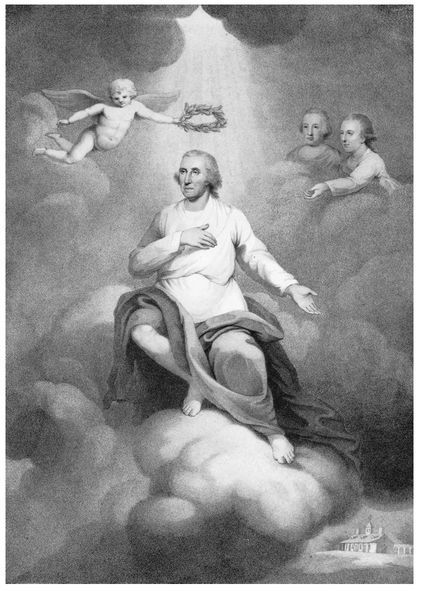
Apotheosis of Washington, by David Edwin, after Rembrandt Peale, engraved circa 1800.
CHAPTER SIXTY-FOUR
Samson and Solomon
FOR AT LEAST A SHORT INTERVAL, the return to Mount Vernon was a heavenly sensation for the wandering Washington family, who experienced again some modicum of normality after their long exile in the nation’s capital. “Since I left Philadelphia, everything has appeared to be a dream,” Nelly Custis told a friend. “I can hardly realize my being here and that grandpapa is no longer in office.”1 As far as Nelly was concerned, the ex-president had been restored to his natural habitat: “Grandpapa is very well and has already turned farmer again.”2 Martha basked in newfound domestic joy. “I cannot tell you, my dear friend,” she wrote to Lucy Knox, “how much I enjoy home after having been deprived of one so long, for our dwelling in New York and Philadelphia was not home, only a sojourning. The General and I feel like children just released from school.”3 Washington invoked his preferred pastoral image of domestic bliss: “I am once more seated under my own vine and fig tree and hope to spend the remainder of my days—which, in the ordinary course of things . . . cannot be many—in peaceful retirement.”4 Relieved to be at home, he spurned a wedding invitation from his nephew Lawrence Augustine Washington, explaining that “I think it not likely that either of us will ever be more than 25 miles from Mount Vernon again.”5
If George Washington expected a belated season of repose, he was bound to be disappointed. Soon after he got home, he had to deal with the death of his sister, Betty Lewis, which filled him with “inexpressible concern.”6 Her death left George and his younger brother Charles as the last survivors of their generation of the Washington clan. Washington generously invited Betty’s son Lawrence to live at Mount Vernon, but he also had an ulterior agenda, thinking his nephew might lift a social burden from his shoulders. “As both your aunt and I are in the decline of life and regular in our habits, especially in our hours of rising and going to bed,” Washington told him, “I require some person . . . to ease me of the trouble of entertaining company, particularly of nights, as it is my inclination to retire . . . either to bed or to my study soon after candlelight.”7 When Lewis delayed joining his uncle, having to deal first with a runaway slave, Washington commiserated: “I wish from my soul that the legislature of this state could see the policy of a gradual abolition of slavery. It would prev[en]t much future mischief.”8
As had happened in December 1783, Washington again encountered a decaying Mount Vernon that had never regained its antebellum efficiency. The buildings looked dilapidated, the furnishings shabby, the soil depleted. With his plantation, Washington seemed to suffer the curse of Sisyphus—he was forever away, forever falling behind, forever forced to rely on undependable help. “We are like the beginners of a new establishment, having everything in a manner to do,” Washington told Elizabeth Powel after surveying the place. “Houses and everything to repair. Rooms to paint, paper, whitewash, etc. etc.”9 A constant parade of carpenters, masons, and painters trooped through the house, kicking up clouds of dust everywhere. So enormous were the repairs that Washington estimated they would cost almost “as much as if I had commenced an entire new establishment.”10
Once again, with Roman fortitude, Washington endured an invasion of unwanted visitors. Far from being a rustic retreat, Mount Vernon became a way station for travelers eager to glimpse the retired national leader. On July 31, 1797, when he invited Tobias Lear to dinner, Washington made this startling comment: “Unless someone pops in unexpectedly, Mrs. Washington and myself will do what I believe has not been done within the last twenty years by us—that is, to set down to dinner by ourselves.”11 Although visitors said they had made the pilgrimage as a mark of respect, the ex-president expressed skepticism about their true motives: “Pray, would not the word curiosity answer as well? And how different this, from having a few social friends at a cheerful board?”12
Many visitors viewed Washington through the golden haze of fame, with no real awareness of his underlying strain, and gushed about his stately serenity. When Amariah Frost of Massachusetts stopped by, he was struck by the exemplary courtesies extended to visitors. After slaves brought rum to him and his companions, they sat down with the Washingtons for a succulent meal consisting of “a small roasted pig, boiled leg of lamb, beef, peas, lettuce, cucumbers, artichokes . . . puddings, tarts, etc.”13 Although Washington led discussions on current affairs, Martha was now also a repository of anecdotes about the historic events of the past quarter century. “The extensive knowledge she has gained in this general intercourse with persons from all parts of the world has made her a most interesting companion, and having a vastly retentive memory, she presents an entire history of half a century,” said a female visitor.14
Fond of routine, Washington returned to his old daily schedule of rising at dawn, eating breakfast, then touring his five farms on horseback in a wide-brimmed hat with a hickory switch in hand. If slaves and overseers weren’t hard at work when he arrived, Washington said only half humorously, he sent them “messages expressive of my sorrow for their indisposition.”15 The considerable demands of refurbishing Mount Vernon caused him to fall behind on correspondence and made sustained reading difficult. As he told Secretary of War McHenry, “I have not looked into a book since I came home, nor shall I be able to do it until I have discharged my workmen; probably not before the nights grow longer, when possibly I may be looking in [the] doomsday book.”16 For all that, Washington remained well informed and enjoyed reading newspapers aloud to company. Since he still complained about their bias, he asked Treasury Secretary Wolcott to send him the unvarnished truth about various issues.
One of Washington’s cherished activities was arranging the huge trove of papers he had lugged back from Philadelphia. Before leaving office, he had instructed his secretaries to skim off documents needed by President Adams and ship the rest to Mount Vernon. He also had them forward a letterpress device so he could make copies of letters. One visitor was staggered by the sheer size of his Revolutionary War archives: “They consist of between 30 and 40 cases of papers, containing all the military expeditions, reports, journals, correspondence with Congress, with the generals, etc. What a wealth of material!”17 As if envisaging the first presidential library, Washington planned to build a house at Mount Vernon dedicated to his records, a project that never came to fruition even though he ordered bookcases for it before his death.