
It was a page torn from Anthony Carroll’s copy of The Odyssey, a printed text annotated with India ink swirls of Shan script, and lines underlined:
My men went on and presently met the Lotus-Eaters, nor did these Lotus-Eaters have any thoughts of destroying our companions, but they only gave them lotus to taste of. But any of them who ate the honey-sweet fruit of lotus was unwilling to take any message back, or to go away, but they wanted to stay there with the lotus-eating people, feeding on lotus, and forget the way home.
Through the translucence of the wet page, Edgar saw more writing and turned the paper. In dark strokes the Doctor had scrawled, “For Edgar Drake, who has tasted.” Edgar read the words again, and slowly lowered his hand, so that the page flapped at his side in the breeze. And again he began to walk, now with less urgency, slowly, perhaps it was only because he was tired. In the distance, the land rose to become the sky, blurring together in watercolor strokes of distant rainstorms. He looked up and saw the clouds, and it was as if they were burning, the pillows of cotton turning to ash. He felt the water from his clothes evaporate, steaming, leaving him as a spirit does the body.
He passed over a rise, expecting to see the river, or perhaps Mae Lwin, but there was only a long road stretching forward to the horizon, and he followed it. In the distance, he saw a single blemish on the open stretch of land, and as he approached, he saw that it was a small shrine. He stopped in front of it. This is an odd place to leave offerings, he thought, There are no mountains or homes, There is no one here, and he stopped and looked over the bowls of rice, the wilted flowers, joss sticks, the now decaying fruit. There was a statue in the spirit-house, a faded wooden sprite with a sad smile and a broken hand. Edgar stopped in the road and took the paper from his pocket, and read it once again. He folded it and tucked it next to the little statue, I leave you a story, he said.
He walked and the sky was light but he saw no sun.
In the afternoon, he saw a woman in the distance. She carried a parasol.
She moved slowly along the road, and he couldn’t tell if she was approaching him or walking away. All was very still, and then from a distant memory came the echoes of a single summer day in England, when he had first taken Katherine’s hand in his and they had walked through Regent’s Park. They had said little, but watched the crowds and carriages, and other young couples. She had departed with only a whisper, My parents are waiting, I will meet you soon, and disappeared across the green beneath a white parasol, which caught the sunlight and danced slightly in the breeze.
He thought now of this moment, the sounds of her voice growing clearer, and he found himself walking fast, now a half-run, until from behind him, he thought he heard hoofbeats, and then a voice, a calling to halt, but he did not turn.
Again, the shout, Halt, and he heard mechanical sounds, clinkings of metal, but they were distant. There was another shout, and then a shot, and then Edgar Drake fell.
He lay on the ground, a warmth spreading beneath him, and he turned and stared at the sun, which had come back, for in 1887, as the histories say, there was a terrible drought on the Shan Plateau. And if they don’t tell of the rains, or of Mae Lwin, or a piano tuner, it is for the same reason, for they came and vanished, the earth turning dry once more.
The woman walks into a mirage, the ghost of light and water that the Burmese call than hlat. Around her, the air wavers, splitting her body, separating, spinning. And then she too disappears. Now only the sun and the parasol remain.
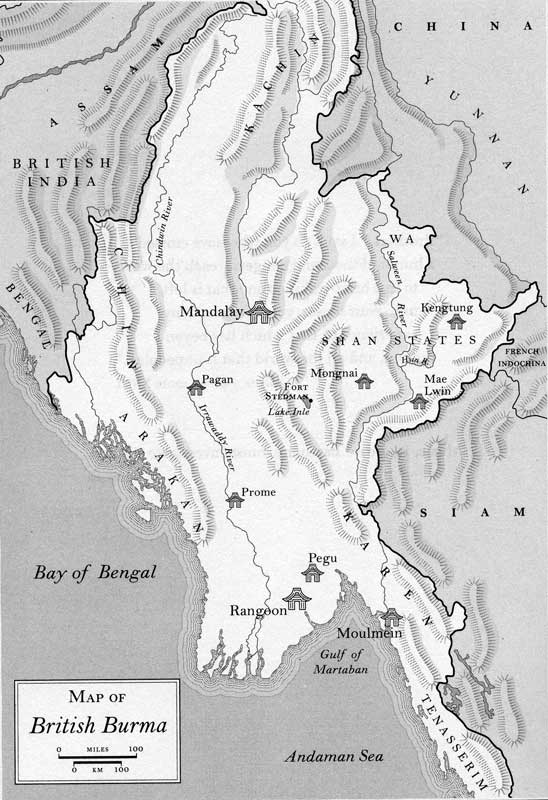
Map of British Burma
Author’s Note
An old Shan monk sat deep in argument with the Hindu ascetic.
The monk explained that all Shans believe that when a man dies, his soul goes to the River of Death, where a boat waits to take him across, and this is why, when a Shan dies, his friends place a coin in his mouth, to pay the ferryman who takes him to the other side.
There is another river, said the Hindu, which must be crossed before the highest heaven is reached. Everyone sooner or later reaches its shore, and has to search out his own way across. To some it is an easy and quick crossing, to others it is a slow and painful struggle to reach the other side, but everyone gets home at last.
Adapted from Mrs. Leslie Milne, Shans at Home (1910)Edgar Drake, Anthony Carroll and Khin Myo, the site of Mae Lwin, and the delivery of an Erard piano to the Salween River are fictional.
Nevertheless, I have attempted to place my story within a true historical context, a task facilitated by the fact that the history and characters of the Shan Revolt are more colorful than any imagination can conjure. All historical briefs in the story, from Burmese history to the Erard piano, contain true information. The pacification of the Shan States represented a critical period in British imperial expansion. The Limbin Confederacy was real, and their resistance determined. My story ends in approximately April 1887, when the principality of Lawksawk was occupied by British forces. Following this military victory, British domination of the Southern Shan States was swift. The Limbin Prince surrendered on May 13, and by June 22 Mr. A. H. Hildebrand, the superintendent of the Shan States, reported that “the Southern Shan States have now all given in their submission.”
True historical figures referred to in this work of fiction include the political officer to the Shan States, Sir James George Scott, who introduced soccer to Burma while principal of St. John’s School in Rangoon, and Burma to me with his scholarly and sympathetic work The Burman, the first academic piece I read on the country and the inspiration for much of the cultural background of my story. His books, from meticulous descriptions of the yôkthe pwè in The Burman, to the encyclopedic compendium of local histories in The Gazetteer of Upper Burma and the Shan States, to the collection of his letters, Scott of the Shan Hills, were an invaluable source of information, as well as an endless pleasure to read.
Dmitri Mendeleev, the father of the periodic table, did meet with the Burmese consul in Paris. What they discussed is still unknown.
Maung Tha Zan was a star of Burmese pwè. He was not as skilled as Maung Tha Byaw.
Belaidour, which Berbers call adil-ououchchn, is known to Western science as Atropa belladonna, and is used primarily for hearts that beat too slowly. It earned its species name because its berries also make women’s eyes wide and dark.
Anthony Carroll’s suspicions about the spread of malaria were correct. That the mosquito carries the disease would be proven ten years later, by another Englishman, Dr. Ronald Ross, also in the Indian Medical Service, but at a different hospital, in the city of Secunderabad. His use of “a plant that came from China” was also prescient. Qinghaosu is now used to make artemisinin, a potent antimalarial drug whose efficacy was “rediscovered” in 1971.
All the sawbwas are real, and still local heroes in the Shan States. The meeting in Mongpu is invented.
As for Twet Nga Lu, the Bandit Prince was captured at last by British forces, and the description of his death, by Sir Charles Crosthwaite, in The Pacification of Burma, is worth quoting here: