
There is no victory when you fight a king, Morgan thought, and did not look back as he left the throne room. Kings always win.
But someday I will be the king.

Lord Chancellor Pasevalles watched from the highest window of Holy Tree Tower as the prince’s procession set out. He had planned to see Prince Morgan and the Hand of the Throne off on their journey, but when the time came, and to his surprise, he found himself awash in painful memories. It had been a bright, warm day when his own father and uncle had set out for Nabban, having cast their lots with Prince Josua, Camaris, and the rest in the great war. That long-ago day had been like this one in other ways, too, especially the mixture of pride, hope, and fear the crowd had felt as loved ones set out into the unknown. As a child he had cheered without reservation, thrilled that his uncle Baron Seriddan and his father Brindalles were off to do a splendid thing on behalf of splendid people. After all, if Sir Camaris himself, the greatest warrior of his age or perhaps any age, had turned up after all hope was past, then how could their cause fail?
And it had not failed. In fact right here in the Hayholt they had sent the undead Storm King back to hell and defeated his mortal lackeys, King Elias and his warlock-priest, Pryrates. But that did not mean that all those who fought against them had survived to enjoy the victory: Pasevalles’s father and uncle would never see their home again, and with them gone, the fabric of his life had begun to fall apart.
All his childhood Pasevalles had devoured stories of heroism and knightly ideals, but after his father’s death, those stories no longer made sense. It was not only people that had died in the Storm King’s War.
Pasevalles stared down at the tide of men on foot and horseback preparing to make their way out of the Middle Bailey and down to the castle gates. From high above, the small army looked almost like a single creature, one of the weird little monstrosities that lived in pools along the shores of the Kynslagh, something with no guiding thought that nevertheless reached for and grasped and consumed what it needed. What were the Sithi going to make of this party of armed mortals? Would they welcome them in, as the king and queen hoped, or would they avoid them as unwanted intruders? Worse still, would they see them as something more dangerous? Pasevalles was not happy that Prince Morgan, the heir-apparent, was being sent on such a mission. Everything he had fought for since becoming Lord Chancellor, every piece of hard work and subtle negotiation, would come to nothing if the prince was lost. And yet King Simon and Queen Miriamele insisted on sending him away. It seemed so careless to Pasevalles, so foolish, that he was just as glad he had exiled himself to this high perch in the castle’s tallest tower.
Do they not understand how close they are to loss at every moment? Do they not understand how suddenly Fate can take their loved ones—just sweep them away, like crumbs brushed from a tablecloth?
He saw a flash of dull gold below—the prince’s hair: Morgan had pulled back his hood to kiss his grandmother’s cheek. Pasevalles felt like a thief or spy, watching their private moment from above.
Is that how God feels sometimes? When He watches but does nothing? Like a spy?
It was a strange, disturbing thought, and Pasevalles shook it off. He walked to the next window, then leaned out until he located Count Eolair, who was talking with the commander of the Erkynguards platoon that would accompany them. Pasevalles knew he would miss Eolair: The lord steward was someone Pasevalles understood, someone who had experienced tragedy in his life and been chastened by it. Like Pasevalles, Eolair recognized the power of Heaven to knock down anything that a man could create, to make a mockery of all hopes and plans. And yet there was Bishop Gervis, only a few yards from Eolair, waving his censer and reciting prayers as though his reedy voice might make God Himself sit up and take notice.
I am angry today, Pasevalles told himself. I must be careful. That is no mood in which to make decisions.
But some days the old wounds simply ached, and there was nothing he could do to soothe them except to take himself away from other people.
He looked up at the sky. That, at least, augured well. A few clouds blew past overhead like sheep who had lost their flock, carried on a wind from the Thrithings, but otherwise the sky was a serious, solemn blue.
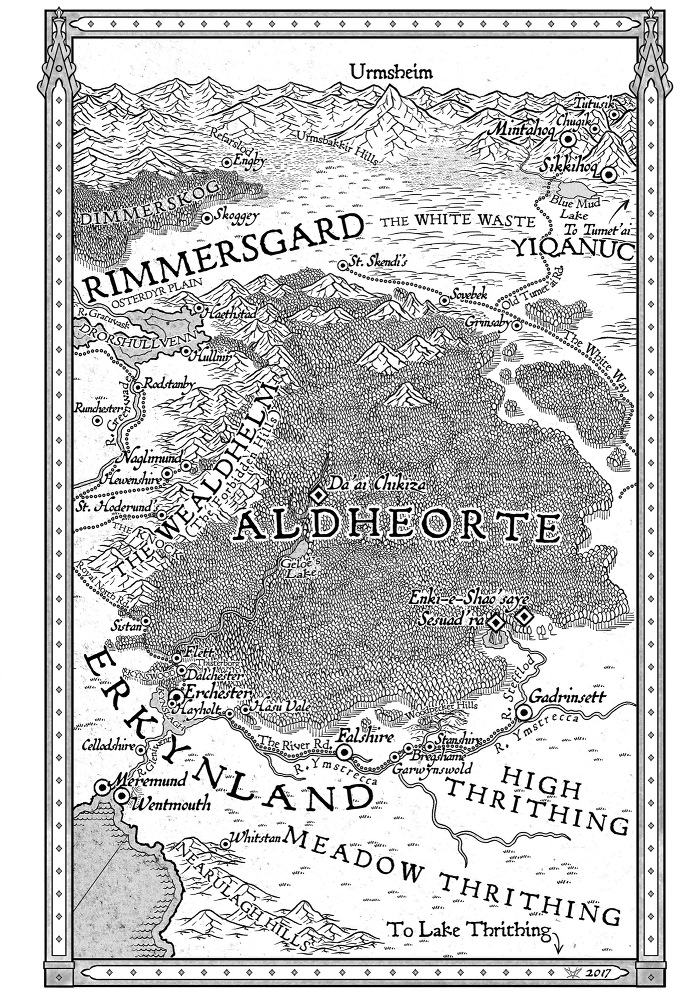
A single trumpet’s blare wafted up from below, then several more. He watched the procession, led by the prince and Eolair, as it made its way toward the Nearulagh Gate and the journey down Main Row through Erchester. How small they were already becoming! How distant! From this height, he could still make out Prince Morgan, but like all the rest of the company, when he turned to look back at his home, the prince had no face. He was nothing more than an actor in all this, as they all were.
As we all of us are, Pasevalles thought. Taking whatever role God gives us and being grateful for it, without ever knowing if we are to be the hero of the story or the butt of the jest.
Too much bitterness, Pasevalles told himself—in fact, too much thinking. He had work to do.
The lord chancellor turned away from the window. He did not watch as the prince, the count, and their company passed through the Hayholt gates and out into the wide, dangerous world.
PART THREE

Exiles
. . . Bring the lute—I will sing,
Fashioning a song of the Desolate City.
The song says:
Border winds hurrying
Above the castle cold.
Well and pathway gone from sight,
Hill and grave mound crumbling.
A thousand years,
Ten thousand ages,
All end thus—
What is there to say?
—Pao Chao
Inhale, exhale
Forward, back
Living, dying
Arrows, let flown each to each
Meet midway and slice
The void in aimless flight—
Thus I return to the source.
—Gesshu Soko
This final scene I’ll not see
to the end—my dream
is fraying.
—Choko
41 Hern’s Horde