
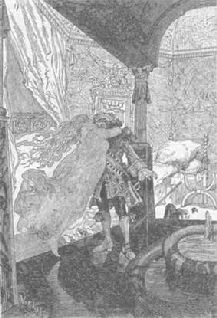
Sublime corruption-not of Gwynplaine, of Yambo. Not only does Josiane offer me more than Isa Barzizza had promised from behind her curtain, but she wins me over with her shamelessness: "You are my husband, begone, this is my lover’s place." Could sin possibly be so heroically overpowering?
Are there, in the world, women like Lady Josiane and Isa Barzizza? Will I ever meet them? Will I remain thunderstruck by them-sffft-just punishment for my fantasies?
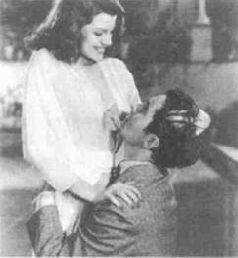
There are, at least on the screen. On another afternoon, furtively, I went to see Blood and Sand. The adoration with which Tyrone Power presses his face into Rita Hayworth’s belly persuades me that some women are armed even when they are not naked. As long as they are brazen.
To be intensely educated about the horror of sin and then to be conquered by it. I tell myself that it must be prohibition that kindles fantasy. Thus I decide that, if I am to escape temptation, I must avoid
the suggestions of an "education in purity": both are the devil’s stratagems, and each sustains the other. This intuition, however heterodox, hits me like a whip.
I withdraw into a world all my own. I cultivate music, always glued to the radio in the afternoon hours, or the early morning, and sometimes they play a symphony in the evening. My family would prefer to listen to other things. "Enough with these dirges," complains Ada, impervious to the muses. One Sunday morning I encounter Uncle Gaetano, now an old man, on the street. He has lost even his gold tooth, or maybe he sold it during the war. He asks benevolently after my studies, and Papà has told him that these days I am obsessed with music. "Ah, music," he says with delight, "how well I understand you, Yambo, I adore music. And all kinds, you know? Any sort, as long as it’s music." He reflects for a moment, then adds: "As long as it’s not classical. Then I turn it off, of course."
I am an exceptional creature exiled among philistines. I sequester myself ever more proudly in my solitude.
In my high school’s first-year reader, I stumble on the verses of several contemporary poets. I discover that one can be illumined by immensity, encounter the evil of living, be pierced by a ray of sunlight. I do not fully understand it, but I like the idea that this is the one thing we can tell you now: what we are not, what we do not desire.
In my grandfather’s shop I find an anthology of the French symbolists. My ivory tower. I merge into a shadowy and profound unity, seeking everywhere de la musique avant toute chose, listening to silences, noting the inexpressible and determining vertigoes.
But to confront such books freely, one must first be freed from many interdictions, so I choose the spiritual director Gianni told me about, the broad-minded priest. Don Renato had seen Going My Way, with Bing Crosby, in which American Catholic priests play piano in their clergyman suits and sing too-ra-loo-ra-loo-ral, too-ra-loo-ra-li to adoring girls.

Don Renato cannot dress like the Americans, but he belongs to the new generation of priests who wear berets and ride mopeds. He does not play the piano, but he has a small collection of jazz records and loves good literature. I tell him that I was advised to read Papini, and he tells me that Papini was most interesting not after he converted, but before. Broad-minded. He loans me The Failure, perhaps thinking that temptations of the spirit may save me from temptations of the flesh.
It is the confession of someone who was never a baby and who had the unhappy childhood of a thoughtful, peevish old toad. That is not me, my childhood was (nomen omen) sunny. But in Solara, in a single haunted night, I lost that. The peevish toad about whom I am now reading is saved by his thirst for knowledge and loses himself in volumes "with green, ragged spines, with huge, wide, crinkled pages, reddish from moisture, often ripped in half or ink-stained." That is me, not only as a child in the attic at Solara but also in the life I later chose. I never emerged from books: I know it now in the continuous wakefulness of this sleep, but I first grasped it in the moment I am presently recalling.
This man, a failure since birth, not only reads, he also writes. I could write, too, could add my own monsters to those that scuttle with their ragged claws across the silent sea floors. That man ruins his eyes over pages on which he sets down his obsessions in muddy ink from inkwells whose bottoms are thick with sludge, like Turkish coffee. He ruined them as a boy, reading by candlelight; he ruined them in the penumbra of libraries, his eyelids reddening. He writes with the help of strong lenses, dogged by fears of going blind. If not blind, then paralytic-his nerves are shot, he has pains and numbness in one leg, his fingers twitch involuntarily, his head shakes badly. He writes with his thick glasses nearly touching the page.
I can see fine, I ride my bike, I am no toad-I may already have my irresistible smile, but what good does it do me? I do not complain that others do not smile at me; it is because I find no reason to smile at others…
I am not like the failure, but I would like to become so. To fashion from his bibliomaniacal fury an opportunity for my own nonmonastic escape from the world. To build a world that is all mine. But I am not moving toward a conversion, if anything, I am coming back from one. Seeking an alternative faith, I become enamored of the decadents. Brothers, sad lilies, I pine for beauty… I become a Byzantine eunuch watching the great white barbarians go by and composing indolent acrostics; I install, by means of science, the anthem of spiritual hearts into the work of my patience, scour atlases, herbals, and rituals.
I can still think of the eternal feminine, as long as I am dazzled by artifice and by some sort of sickly pallor. I read, and am aroused- above the neck:
This dying girl whose garments he was touching inflamed him as did the most ardent of females. There was no bayadère on the banks of the Ganges, no odalisque from the baths of Istanbul, no naked Bacchante who ever existed whose embrace could have made his bone marrow boil as much as the touch, the simple touch of that fragile, febrile hand whose sweat he could feel through the glove that covered it.
I do not even have to confess to Don Renato. It is literature, I am permitted its company, even if it speaks to me of perverse nudities and androgynous ambiguities. They are far enough from my experience that I can yield to their seduction. It is word, not flesh.
Toward the end of my second year of high school, I stumble on À rebours, by Huysmans. His hero, Des Esseintes, comes from a long line of grim, muscular warriors with yataghan mustaches, but ancestral portraits reveal a gradual impoverishment of the stock, sapped by too much inbreeding: his forebears already appear weakened by an excess of lymph in the blood, exhibit feminine traits and anemic, nervous faces. Des Esseintes is marked from birth by these atavistic evils: his is a dismal childhood, fraught with scrofula and stubborn fevers, and his mother, long, silent, and pale, always entombed in a dark room in one of their châteaux, in the faint glow of a lampshade that shields her from excessive light and noise, dies when he is seventeen. Left to himself, the boy looks through books on rainy days and in nice weather goes for walks in the country. "His greatest pleasure was going down into the gorge as far as Jutigny," a village at the foot of the hill. Into the Gorge. He stretches out in the fields, listens to the muffled sound of the water mills, then climbs to the top of a ridge from where he can see the Seine valley,