
… My little son
in a yellowed Latin book of mine discovered-can you guess?-a pansy… Why did a teardrop tremble in my eye? Oh who knows, who knows why…
And myself? The comic books in the chapel told me that I had been exposed to revelations of sex-but what about love? Had Paola been the first woman in my life?
It was strange that nothing in the chapel dated from the period between my thirteenth and eighteenth years, for during those five years-that was before the disaster-I still went to the house regularly.
I suddenly recalled having glimpsed three boxes that had not been on the shelves, but up against the altar. I had paid them little mind, caught up as I was in the multihued allure of my collections, but perhaps they were worth a look.
The first box was full of photographs of my childhood. I expected some great revelation, but no. I felt only a powerful, religious emotion. Having seen the photos of my parents in the hospital and the one of my grandfather in his study, I was able to identify them, even at different ages, by their clothes, recognizing them as younger or older depending on the length of my mother’s skirt. That child in the sun hat poking the snail on the rock must have been me; that toddler solemnly holding my hand was Ada; Ada and I were the creatures in white outfits, almost a tailcoat for me, almost a bridal gown for her, on the occasion of a first communion or confirmation; I was the second Balilla Boy on the right, standing in line with my little musket clasped to my chest, one foot forward; and there I was, a little older, standing next to a black American soldier who had a sixty-four-tooth smile, perhaps the first liberator I had met and had myself immortalized with after April 25.
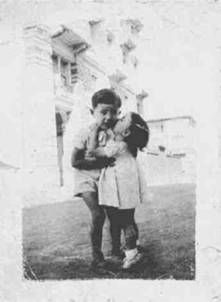
Only one of the photos truly moved me: a snapshot (which had been enlarged, you could tell by the blurriness) showing a little boy leaning slightly forward, embarrassed, as a tiny girl tipped up on little white shoes, put her arms around his neck, and kissed him on the cheek. Mamma or Papà must have caught us unawares, as Ada, tired of posing, spontaneously rewarded me with sisterly affection.
I knew the boy was me and the girl was her, and I could not help being affected by the sight, but it was as if I had seen it in a movie, and I was moved as a stranger might be before an artistic representation of brotherly love. The way one is moved by Millet’s An-gelus, Hayez’s The Kiss, or a pre-Raphaelite Ophelia floating upon a blanket of jonquils, water lilies, and asphodels.
Were they really asphodels? How should I know, once again it was the word flexing its muscle, not the image. People say our brains have two hemispheres: the left, which presides over rational relationships and verbal language, and the right, which deals with emotions and the visual universe. Perhaps my right hemisphere was paralyzed. And yet it was not, because there I was dying of consumption in my quest for something or other, and a quest is a passion, not a dish served cold like revenge.
I put away the photos, which only made me nostalgic for the unknown, and took out the second box.
It contained holy cards, many of Domenico Savio, a pupil of Don Bosco’s, whose ardent piety the painters revealed by depicting him in creased trousers that sagged beneath his knees, as if he kept them bent all day, lost in prayer. Then a little volume with a black binding and red edges, like a breviary: The Provident Young Man, by Don Bosco himself. An 1847 edition, in rather bad shape-who knows who had passed it down to me. Edifying readings and collections of hymns and prayers. Many of them exalting purity as the highest virtue.
Other pamphlets, too, contained ardent exhortations to purity, invitations to abstain from wicked spectacles, dubious company, and dangerous readings. It seemed that of all the commandments the sixth was the most important, not committing impure acts, and many of the teachings were rather transparently directed against the illicit touching of one’s own body, to the point of advising young readers to lay themselves down at night in a supine fashion, their hands crossed over their chests, so that their bellies would not press into the mattress. Warnings against contact with the opposite sex were rare, as if the likelihood of that were remote, impeded by strict social conventions. The prime enemy, though the word was generally avoided in favor of cautious circumlocutions, was masturbation. One little handbook explained that the only animals that masturbate are fish: it must have been alluding to external insemination; many fishes spill their spermatozoa and their eggs into the water, which then takes care of the fertilization-meaning that those poor creatures were not sinning by spilling their seed in improper vessels. Nothing about apes, for whom onanism is a calling. And silence regarding homosexuality, as if allowing oneself to be touched by a seminarian were no sin.
I also picked up a very worn copy of Don Domenico Pilla’s Little Martyrs. It is the story of two pious youths, a boy and a girl, who suffer the most horrible tortures at the hands of anticlerical, Satan-worshipping Freemasons who, out of hatred for our blessed religion, want to initiate the youths into the joys of sin. But crime does not pay. The sculptor Bruno Cherubini, who had carved the Statue of Sacrilege for the Masons, is wakened at night by the apparition of his partner in debauchery, Volfango Kaufman. After their last orgy, Volfango and Bruno had made a pact: the first to pass on would return to tell the other what awaited in the great beyond.
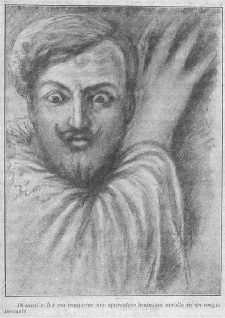
Thus Volfango emerges postmortem from the mists of Tartarus, wrapped in a shroud, his eyes bulging from his Mephistophelian face. His incandescent flesh glows with a sinister light. The ghost identifies himself and declares: "Hell exists, and I’m there!" And he tells Bruno, "If you want proof, extend your right hand"; the sculptor obeys and the specter lets fall a droplet of sweat that passes through Bruno’s hand from one side to the other, like molten lead.
The dates of the book and the pamphlets, even when given, told me nothing, because I could have read them at any age, and so I was unable to determine whether it was during the last years of the war or after my return to the city that I had gone in for pious practices. Was it a reaction to the war’s events, a way of dealing with the tempests of puberty, or a series of disappointments that had sent me into the welcoming arms of the Church?
The only real scraps of myself were in the third box. On the very top, several issues of Radiocorriere from ’47 and ’48, with certain programs marked and annotated. The handwriting was unquestionably mine, and hence those pages told me what I alone had wanted to hear. The underlined entries, except for a few late-night programs devoted to poetry, were mostly chamber and concert music. They were brief entr’actes between one program and another, early in the morning, in the afternoon, or late in the evening: three etudes, a nocturne, on a good day an entire sonata. Strictly for die-hard fans, scheduled in the off-hours. After the war, then, back in the city, I had eagerly awaited those musical events, slowly becoming an addict, glued to the radio, which I turned down low so as not to disturb the rest of my family. My grandfather had some classical records, but who can say he did not buy them later, precisely to encourage my new passion? Before that, I had noted down like a spy the rare occasions when I could listen to my music, and who knows how angry I felt, going into the kitchen for a long-awaited date and being prevented from listening by shuffling busybodies or nattering salesmen, by women tidying up or rolling out sheets of dough for pasta.