
But how did it happen that I had saved those copies of my mother’s magazine? When I returned to Solara in late adolescence, already in high school, I must have begun to salvage evidence of what even then felt like the distant past, thus devoting the dawn of my youth to retracing the lost steps of my childhood. I was already condemned to the salvaging of memory, except that back then it was a game, with all my madeleines at my disposal, and now it was a desperate struggle.
In the chapel I had in any case understood something about my discovery of the flesh and the way it both frees and enslaves. Well, that was one way to escape the thralldom of marching, uniforms, and the asexual empire of the Guardian Angels.
Was that all? Except for the Nativity scene in the attic, for example, I had found no clues to my religious feelings, and it seemed to me impossible for a child not to have harbored some, even in a secular family. And I had not found anything to shed light on what had happened from 1943 on. It may have been precisely between 1943 and 1945, after the chapel had been walled shut, that I had stashed within it the most intimate evidence of a childhood that was already blurring in the soft focus of memory: I was assuming the toga of manhood, becoming an adult in the maelstrom of the darkest years, and I had decided to conserve in a crypt a past to which I would devote my adult nostalgia.
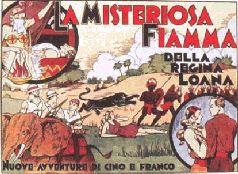
Among the many Tim Tyler’s Luck albums, I finally stumbled on one that made me feel I was on the cusp of some final revelation. It had a multicolored cover and was entitled The Mysterious Flame of Queen Loana. There lay the explanation for the mysterious flames that had shaken me since my reawakening, and my journey to Solara was finally acquiring a meaning.
I opened the album and encountered the most insipid tale ever conceived by the human brain. It was a ramshackle story, no part of which held water: events were repetitive, characters fell instantly in love, for no reason, and Tim and Spud find Queen Loana sort of charming and sort of evil.
Tim and Spud and two friends, while traveling in Central Africa, stumble on a mysterious kingdom in which an equally mysterious queen is the guardian of an ultra-mysterious flame that grants long life, immortality even, considering that Loana, still beautiful, has been ruling over her savage tribe for two thousand years.
Loana enters the picture at a certain point, and she is neither alluring nor unsettling: she reminded me of certain parodies from early variety shows that I had recently seen on television. For the rest of the story, until she hurls herself out of lovesickness into a bottomless abyss, Loana goes hither and thither, pointlessly enigmatic, through an incredibly slipshod narrative that lacks both charm and psychology. She wants only to marry one of Tim and Spud’s friends, who resembles (two peas in a pod) a prince she loved two thousand years before, whom she had killed and petrified when he refused her charms. It is unclear why Loana needs a modern double (especially one who does not love her either, having in fact fallen in love at first sight with her sister), considering that she could use her mysterious flame to bring her mummified lover back to life.
I noticed there, as I had in other comics, that neither the femmes fatales nor the satanic males (think of Ming with Dale Arden) ever sought to ravish, rape, imprison in their harems, or know carnally the objects of their lust. They always sought to marry them. Protestant hypocrisy of American origin, or an excess of bashfulness imposed on the Italian translators by a Catholic government waging a demographic battle?
As for Loana, a variety of catastrophes ensue, the mysterious flame is extinguished forever, and for our protagonists it is good-bye immortality, which must not be such a big deal, given that they have dragged their feet so much in its pursuit and that in the end having lost the flame seems to matter very little to them-and to think they started all that hullabaloo to find it. Perhaps the authors ran out of pages, had to end the album somehow, and could no longer quite recall how or why they had begun.
In short, an incredibly dumb story. But apparently it had come across my path just as Signor Pipino had. You read any old story as a child, and you cultivate it in your memory, transform it, exalt it, sometimes elevating the blandest thing to the status of myth. In effect, what seemed to have fertilized my slumbering memory was not the story itself, but the title. The expression the mysterious flame had bewitched me, to say nothing of Loana’s mellifluous name, even though she herself was a capricious little fashion plate dressed up as a bayadère. I had spent all the years of my childhood-perhaps even more- cultivating not an image but a sound. Having forgotten the "historical" Loana, I had continued to pursue the oral aura of other mysterious flames. And years later, my memory in shambles, I had reactivated the flame’s name to signal the reverberation of forgotten delights.
The fog was still, as always, within me, pierced from time to time by the echo of a title.
Poking around haphazardly, I picked out a clothbound album, in landscape format. As soon as I opened it I saw that it was a collection of stamps. Clearly mine, as it bore my name at the beginning, with the date, 1943, when I presumably began collecting. The album seemed almost professionally done, with removable pages, organized alphabetically by country. The stamps were attached with hinges, though some-Italian stamps from those years, the discovery of which on envelopes or postcards may well have inaugurated my philatelic period-were thickened, their backs rough, crusted with something. I deduced that I had started out by attaching them to some cheap notebook using gum arabic. Apparently I had later learned how it was done and had tried to salvage that first draft of a collection by submerging the notebook pages in water. The stamps had come off, but had retained the indelible signs of my foolishness.
That I later learned how it was done was evidenced by a book underneath the album, a copy of Yvert and Tellier’s 1935 catalogue, which I had probably found amid my grandfather’s junk. That catalogue was clearly obsolete for the serious collector of 1943, but evidently it had become precious to me, and I had learned from it not the current prices or latest issues, but the method, the technique of cataloguing.
Where had I obtained stamps in those years? Had my grandfather passed them on to me, or could a person buy envelopes of assorted stamps in stores, as they do today in the stalls between Via Armorari and the Cordusio in Milan? I probably invested all of my scant capital with some stationer in the city, one who specialized in selling to budding collectors, and so those stamps that to me seemed straight from fairy tales represented currency. Or perhaps, in those years of war, with the curtailment of international trade-and domestic, too, eventually-materials of some value found their way onto the market, and at low prices, sold perhaps by some retiree in order to be able to buy butter, a chicken, a pair of shoes.
For me, that album must have been, more than a material object, a receptacle of oneiric images. I was seized with a burning fervor at the sight of each figure. Forget the old atlases. Looking through that album I imagined the clear blue seas, framed in purple, of Deutsch-Ostafrika; I saw the houses of Baghdad, framed by a tangle of Arabian-carpet lines, against a night-green background; I admired a profile of George V, sovereign of the Bermudas, in a pink frame against a blue field; the face of the bearded pasha or sultan or rajah of the Bijawar State-perhaps one of Salgari’s Indian princes-subdued me with its shades of terracotta; certainly the little pea-green rectangle from the Labuan Colony was rich in Salganan echoes; perhaps I was reading about the war that was started over Gdansk as I was handling the wine-colored stamp marked Danzig: on the stamp of the state of Indore, I read FIVE RUPEES in English; I daydreamed about the strange native pirogues outlined against the